Menu
 1.866.668.5111
 6:30 am - 6:00 pm

 Give a Happy High Five!

November 24, 2026
Your Toddler’s Future SAT Scores? Early Language, Big Possibilities, and Staying Playful
Eden Stafstrom, MA PhD ABD, Spanish Immersion Curriculum & Program Manager
Parents want to give their children the strongest possible start. We read about school readiness, academic achievement, and the importance of the first five years, and it can begin to feel as though every early experience carries enormous consequences.
Should we be teaching babies more vocabulary? Should toddlers be practicing letters and numbers? If early learning predicts later achievement, do parents need to turn playtime into preparation for kindergarten or even the SAT?
Fortunately, supporting early learning does not mean turning babyhood into test prep. Research does show a meaningful relationship between early language development and later academic outcomes. But that relationship is more complex (and much more hopeful) than the idea that teaching a toddler a certain number of words will guarantee a particular test score.
Early language provides a foundation for later learning. Some of the most developmentally appropriate ways to build that foundation are also the simplest and most joyful: talking, reading, singing, playing, and responding to children’s interests.
Does a Toddler’s Vocabulary Predict Later Achievement?
Longitudinal research has found associations between children’s early expressive vocabulary and their academic performance years later.
In one large study of more than 2,000 Danish children, vocabulary measured between 16 and 30 months was associated with language, reading, and mathematics outcomes in sixth grade. The relationship was strongest for language and literacy, although an advanced early vocabulary was also associated with higher mathematics performance. Another large study found that early vocabulary in toddlers could help predict academic outcomes at age 15, alongside factors such as family background and early learning experiences.
These findings are striking, but they need to be interpreted carefully. Early vocabulary was a predictor, not a prophecy. A toddler with a large vocabulary is not guaranteed high test scores, and a child who begins speaking later is not destined to struggle academically. In other words, early vocabulary is one meaningful part of a much larger developmental picture. Though the relationship between early language and future success is complex, it is still worth investing in early language development.
 Why Early Language Matters
Language supports far more than the ability to name objects. Children use language to organize ideas, understand relationships, remember experiences, ask questions, solve problems, and connect new information with what they already know.
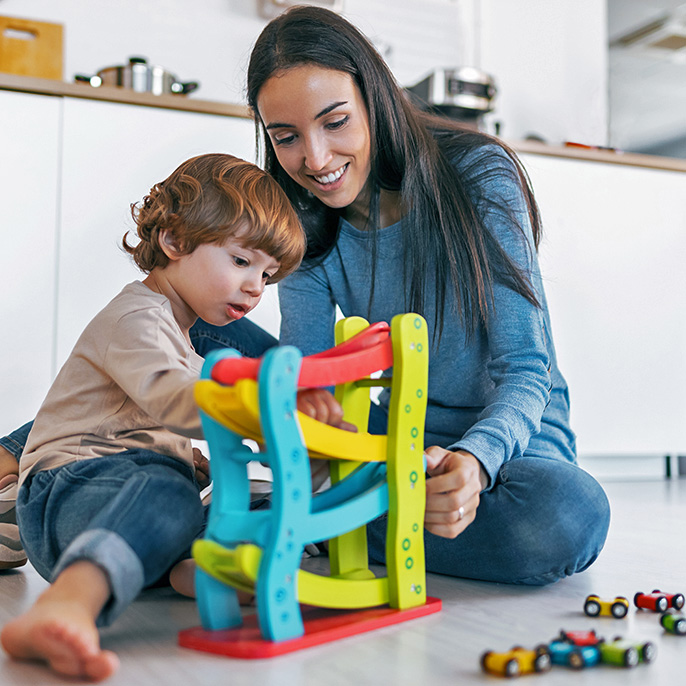
Consider a child exploring a ramp with a toy car. Through conversation, that experience can become an opportunity to encounter ideas such as fast, slow, higher, lower, roll, stop, and again. During pretend cooking, children may hear words related to quantities, sequences, textures, tools, and family routines. A picture book can introduce animals, places, emotions, and events that children may not encounter in everyday life.
Vocabulary is therefore connected to both language and knowledge. Words give children tools for thinking and communicating about what they observe.
This helps explain why early language skills may be associated most strongly with later literacy. Reading comprehension requires more than recognizing printed words. Children also need to understand the meanings of those words, follow relationships between ideas, make inferences, and connect a text with their existing knowledge.
Early language helps build that foundation- but it grows most effectively through meaningful interaction (playing with toy cars, pretending to cook, reading a book), not memorization.
Talking Around a Child Is Not the Same as Talking With a Child
One important study examined the everyday language environments of Spanish-speaking families with infants. Researchers found that children who experienced more speech addressed directly to them developed more efficient real-time language-processing skills and larger expressive vocabularies by 24 months. By contrast, speech that children merely overheard in adult conversations was not associated with the same vocabulary outcomes.
Another study examined how many words 12- to 18-month-old children learned after watching a commercially available infant-learning DVD several times a week for one month. The researchers found that children who watched the DVD did not learn more of the target words than children in a control group who did not watch it at all. It was as if the children’s brains did not even register the language on the TV.
These distinctions are important. Young children do not learn language simply by being surrounded by sound. Their brains are wired to soak up new language from face-to-face interactions with their caregivers.
When a baby looks at a dog and a caregiver says, “Look at that dog! He’s running after the ball!” the adult is responding to the child’s attention and adding meaningful language. When a toddler points toward a shelf and an adult asks, “Would you like a book?” the child learns that gestures and sounds can influence another person. When the adult pauses and allows the child to respond, the exchange becomes a conversation, even if the child is not yet using complete words.
These interactions help children connect sounds with objects, actions, intentions, and emotions. They also give children opportunities to practice processing language in real time.
 Play Is Not a Break From Learning
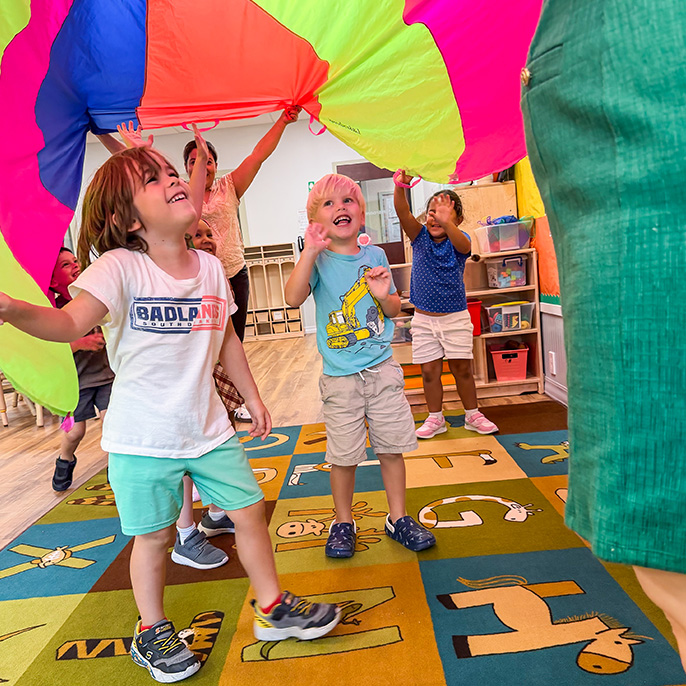
The pressure to prepare children academically can make play seem less important than formal instruction. But for babies, toddlers, and preschoolers, play is the primary context in which learning occurs.
During play, children are motivated to attend, communicate, predict, experiment, and repeat. They hear language connected to something they can see, touch, move, or imagine. Adults are able to introduce new words naturally because the child already has context to understand them. A simple block tower can lead to language about size, position, balance, color, counting, and cause and effect. A dance can introduce body parts, directions, speed, rhythm, and patterns. Pretend play can help children explore roles, routines, emotions, and sequences. Songs make language memorable through melody, movement, rhythm, and repetition.
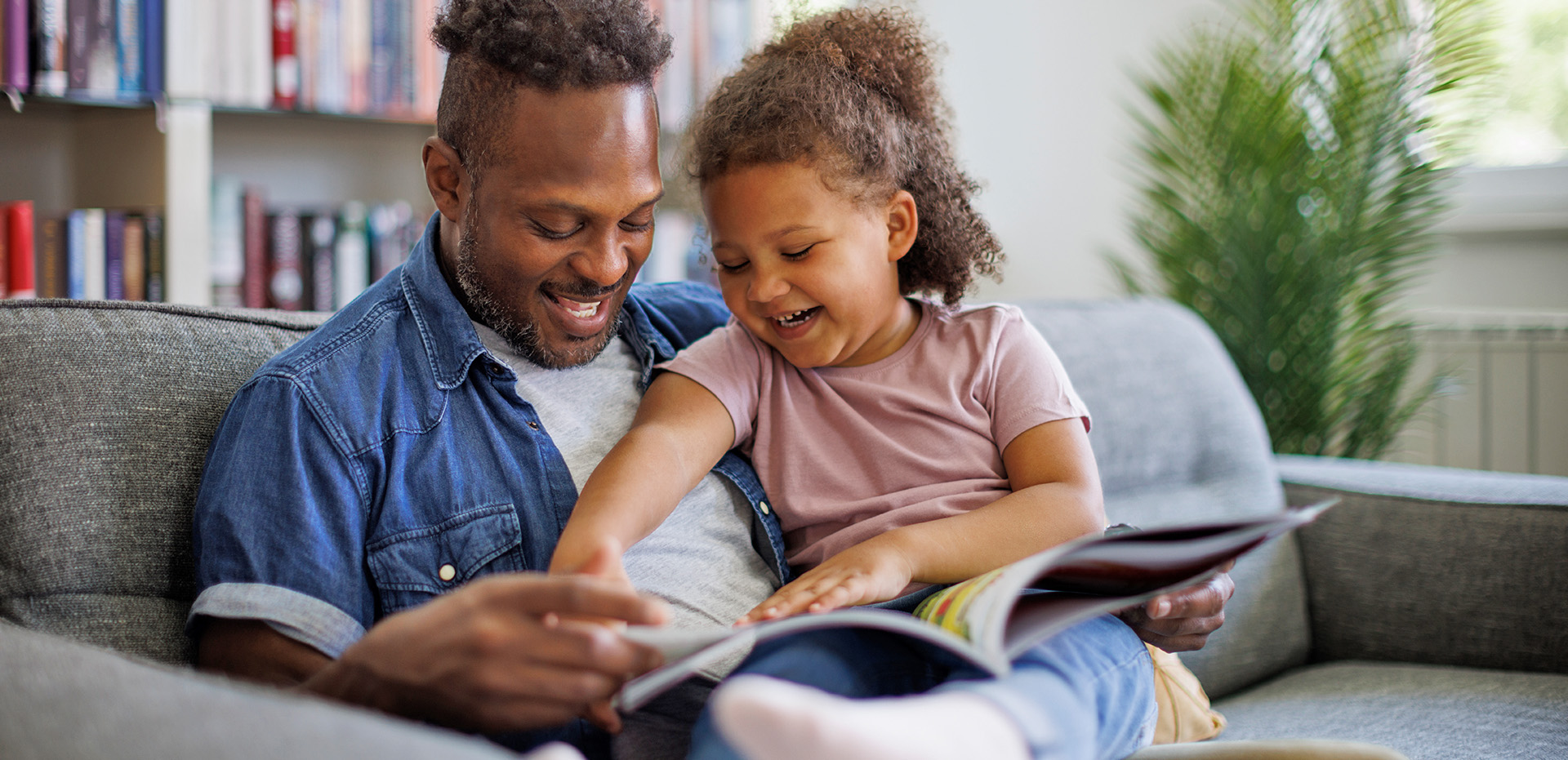
Shared reading offers another especially rich opportunity. Books expose children to rich vocabulary, complex sentence structures, novel characters, and new ideas that may not arise in everyday conversation. The goal, however, is not to race through the words or quiz a child at the end. Adults should point, pause, react, imitate sounds, connect the story to the child’s experiences, and follow the child’s attention.
These playful exchanges are not less educational because they are enjoyable. Their enjoyment is part of what makes children want to participate and learn more.
Turning the Research Into Everyday Practice
Parents do not need specialized materials, formal lesson plans, or stacks of vocabulary cards to support early language. Some of the most valuable opportunities are already built into the day.
Families can:
- Notice what interests the child and talk about it.
- Respond to babbling, gestures, facial expressions, and words as meaningful communication.
- Add a little language to what the child already understands.
- Read together without turning the book into a test.
- Repeat favorite stories and songs.
- Use language during meals, dressing, bath time, errands, and outdoor play.
- Sing songs that pair words with movements.
- Ask questions while also allowing time for the child to respond.
- Continue using the language in which each caregiver can communicate most naturally and richly.
- Make space for conversation without expecting perfect pronunciation or complete sentences.
None of these interactions needs to feel like a lesson. The purpose is not to make a child perform. It is to build a warm, responsive environment in which language is useful, interesting, and connected to real experiences.
How ¡Vamos! And Bravo! Keeps Early Learning Playful
The Doodle Bugs! Bravo! and ¡Vamos! curricula share a central understanding: early language and broader learning develop together, and young children learn best when they are actively engaged in experiences they enjoy.
Throughout the day, Bravo! surrounds children with rich English-language experiences connected to early literacy, STEAM, art, music, movement, imaginative play, and social-emotional development. Teachers build language naturally as they read stories, ask questions, introduce new ideas, respond to children’s interests, and help them describe what they are discovering.
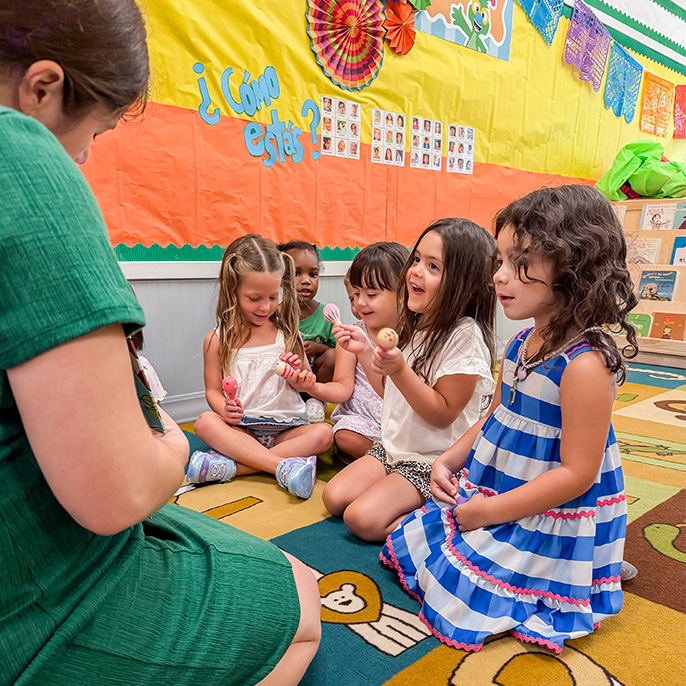 ¡Vamos! extends this playful, responsive approach into Spanish. Children explore the language through stories, songs, games, movement, authentic literature, cultural experiences, and hands-on activities. Rather than memorizing disconnected vocabulary lists, they encounter words and sentences within experiences that make them meaningful. A child might explore rápido and lento while moving to music or encounter words like luna and cohete during a space investigation.
Both programs offer something passive exposure cannot: responsive interaction with teachers and classmates. Children can listen, watch, point, move, gesture, laugh, make choices, ask questions, and gradually participate in increasingly complex ways. Teachers notice their responses, follow their interests, and add language that helps them understand and communicate more.
Because ¡Vamos! is intentionally aligned with Bravo!, the two programs reinforce one another. Children can encounter related ideas through English and Spanish while building vocabulary, background knowledge, listening comprehension, creativity, problem-solving skills, and confidence. They learn that language is not simply a school subject; it is a tool for exploring the world and connecting with other people.
These playful experiences help build foundations for later literacy, learning, and academic success without turning early childhood into test preparation. Children are developing important skills, but from their perspective, they are singing, creating, experimenting, imagining, moving, and having fun. Most importantly: they learn to love learning.
Big Possibilities Without Big Pressure
No single activity can determine a child’s future test scores, and no parent or teacher can engineer a child’s future success. What we can do is create language-rich environments where children feel safe to wonder, communicate, experiment, and return to ideas that capture their interest. Over time, those everyday interactions help build the vocabulary, knowledge, confidence, and curiosity that support later learning.
The best preparation for the future often looks remarkably like childhood play: sharing stories, singing songs, building something together, or following a child’s question wherever it leads. When families and educators keep language responsive, meaningful, and playful, children gain more than just words. They develop a genuine love of learning- and that may be one of the most valuable foundations we can give them.
Sources:
Bleses, D., Makransky, G., Dale, P. S., Højen, A., & Ari, B. A. (2016). Early productive vocabulary predicts academic achievement 10 years later. Applied Psycholinguistics, 37(6), 1461–1476. https://doi.org/10.1017/S0142716416000060
Dale, P. S., Paul, A., Rosholm, M., & Bleses, D. (2023). Prediction from early childhood vocabulary to academic achievement at the end of compulsory schooling in Denmark. International Journal of Behavioral Development, 47(2), 123–134. https://doi.org/10.1177/01650254221116878
DeLoache, J. S., Chiong, C., Sherman, K., Islam, N., Vanderborght, M., Troseth, G. L., Strouse, G. A., & O’Doherty, K. (2010). Do babies learn from baby media? Psychological Science, 21(11), 1570–1574. https://doi.org/10.1177/0956797610384145
Weisleder, A., & Fernald, A. (2013). Talking to children matters: Early language experience strengthens processing and builds vocabulary. Psychological Science, 24(11), 2143–2152. https://doi.org/10.1177/0956797613488145
Yogman, M., Garner, A., Hutchinson, J., Hirsh-Pasek, K., & Golinkoff, R. M. (2018). The power of play: A pediatric role in enhancing development in young children. Pediatrics, 142(3), e20182058. https://doi.org/10.1542/peds.2018-2058